
That "Free Local Report" Is a Sales Tool, Not an Audit
August 7, 2026 · PinPointMAPS.us
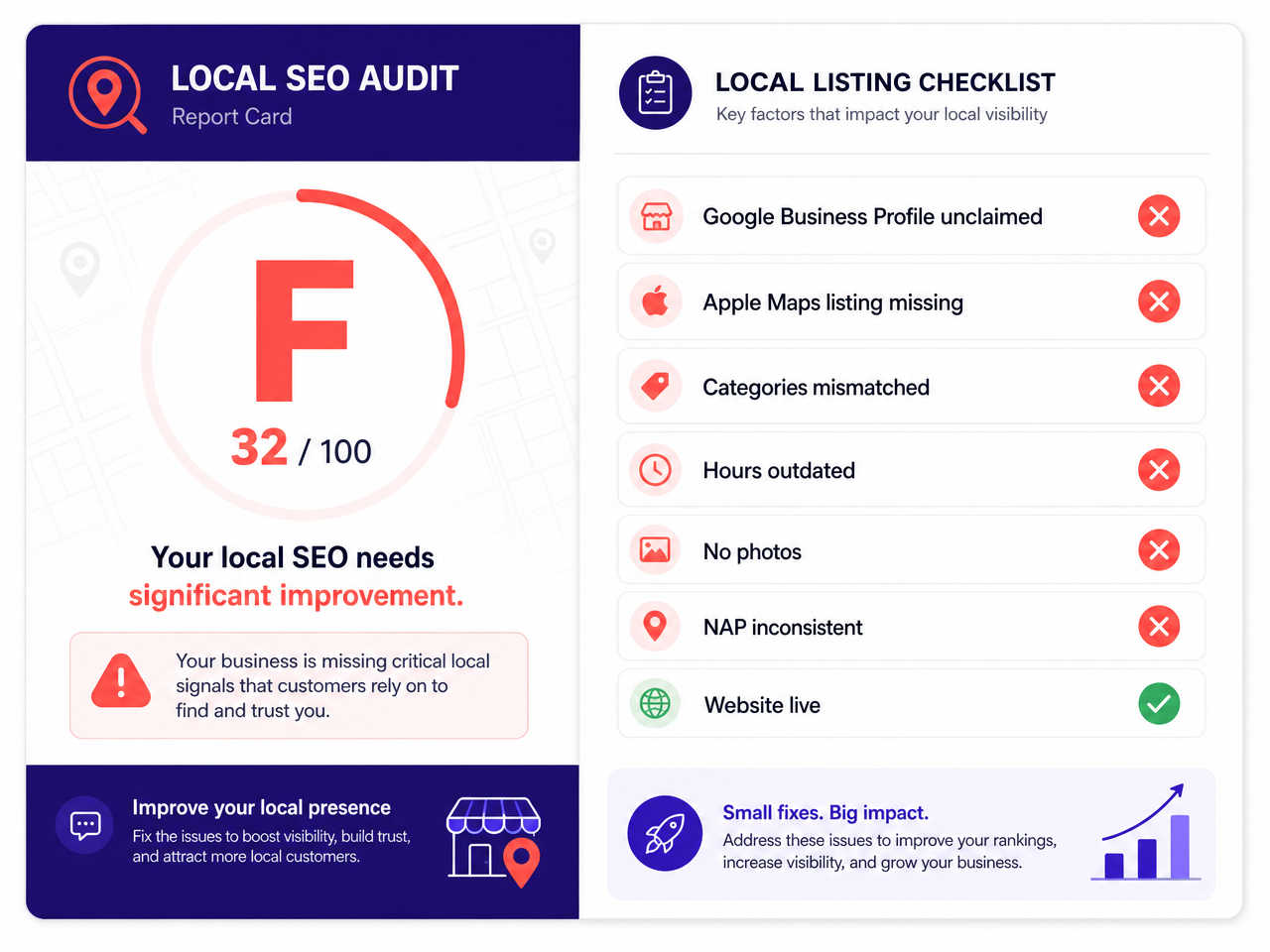
𝗠𝗼𝘀𝘁 𝗳𝗿𝗲𝗲 𝗹𝗼𝗰𝗮𝗹 𝗹𝗶𝘀𝘁𝗶𝗻𝗴 𝗮𝗻𝗱 𝘄𝗲𝗯 𝗽𝗿𝗲𝘀𝗲𝗻𝗰𝗲 𝗴𝗿𝗮𝗱𝗲𝗿𝘀 𝗮𝗿𝗲 𝗯𝘂𝗶𝗹𝘁 𝘁𝗼 𝗺𝗮𝗸𝗲 𝘆𝗼𝘂𝗿 𝗯𝘂𝘀𝗶𝗻𝗲𝘀𝘀 𝗹𝗼𝗼𝗸 𝗯𝗿𝗼𝗸𝗲𝗻. 𝗛𝗲𝗿𝗲 𝗶𝘀 𝗵𝗼𝘄 𝘁𝗼 𝘀𝗽𝗼𝘁 𝗮 𝗿𝗶𝗴𝗴𝗲𝗱 𝗿𝗲𝗽𝗼𝗿𝘁 𝗮𝗻𝗱 𝘄𝗵𝗮𝘁 𝘁𝗼 𝗺𝗲𝗮𝘀𝘂𝗿𝗲 𝗶𝗻𝘀𝘁𝗲𝗮𝗱.
You have seen the ad. Enter your business name, get an instant "Local Visibility Score," and watch a dashboard fill up with red X marks. Your listings are inconsistent. Your citations are missing. Your score is 41 out of 100. The whole thing feels like a diagnosis.
It usually is not. Most of these tools are lead magnets first and audits second. The report is not measuring your business as much as it is manufacturing a problem, and the fix is always the same: a monthly subscription to the company that just scared you.
I have spent years cleaning up after these reports. Here is how they work and how to tell a real one from a sales pitch dressed up as data.
The score is not a real score
There is no industry standard for local visibility. No governing body defines what a 41 means or what a 90 requires. Every tool invents its own scale and weights it however the vendor wants.
That is the whole trick. If you build the scoring rubric, you decide what counts as a failure. Weight "citation coverage" heavily enough and a business that ranks in the top three on Google Maps can still score in the 40s. The number is not describing your performance. It is describing the gap between where you are and where the vendor's product happens to sell.
Ask any vendor what a good score is and how it is calculated. If they cannot show you the math, the number is decoration.
The missing listings are on sites nobody uses
The most common red flag on these reports is a long list of directories where your business is "not found." Brownbook. BOTW. Citysearch. Dozens more you have never heard of, because nobody has.
That list is the sales hook. The report counts absences on sites with no traffic, calls them errors, and sells you the package that fills them in. Watching businesses spend tens of thousands of dollars on exactly that is why I started PinPointMAPS.
What matters for this post is what the list reveals about the tool. Forty missing directory listings is not forty problems. It is one product, counted forty times.
The color coding does the persuading
Watch what these dashboards mark yellow. Not wrong, not missing, just yellow. A description that could be "more optimized." Photos that are "below average." A field that is technically complete but flagged anyway.
Almost nothing is ever green. That is deliberate. A report that showed you doing fine would end the conversation, and the conversation is the point. Every ambiguous item defaults to a warning color because warning colors generate calls.
The benchmark is unverifiable
"You rank below 73% of similar businesses in your area." Which businesses? Chosen how? Measured from what location, on what search, on what day?
Local results shift by the block. A rank grid can be zoomed in or out, centered anywhere, and set to any keyword, and the vendor controls all three settings. Pull the map pin a mile in the right direction and a sea of red turns green. If the report does not disclose the search terms, the grid radius, and the center point, the comparison is not reproducible and it is not evidence.
The duplicate listings are usually not duplicates
Reports love to flag "duplicate listings detected." Most of the time these are service area variants, an old location Google already merged, or a suite number formatted two different ways. Google resolves the vast majority of these on its own.
Real duplicates exist and they do cause problems. But a tool that counts every string mismatch as a crisis is padding a list, not solving anything.
One test exposes almost all of them
Run the same report twice, a day or two apart, having changed absolutely nothing.
If the score moves, the score is noise. If it stays identical while the tool insists your situation is urgent, ask which specific items on that list have ever changed a customer's behavior. Not rankings. Not scores. Behavior: calls placed, directions requested, website clicks, bookings made.
A vendor who can connect their findings to those four things is worth a conversation. A vendor who pivots back to the score is selling the score.
What is actually worth measuring
You already own the only local data source that cannot be manipulated by a vendor. It is the Performance tab inside your Google Business Profile, and it is free.
Look at these, month over month:
Calls, direction requests, and website clicks. These are actions, not impressions. They are the closest thing to revenue that Maps gives you.
Discovery versus direct searches. Direct means people typed your name. Discovery means they searched a category and found you. Growth in discovery is real visibility growth.
The search terms people used. Google shows you the queries that surfaced your profile. This tells you whether your categories and services are matched to how customers actually search.
Review velocity and response rate. A steady flow of recent reviews with owner responses does more for conversion than any citation package ever sold.
Photo and post recency. Profiles that go quiet look closed. Profiles that publish look open.
None of that requires a subscription to find. It requires somebody to look at it every month and act on it, which is the part most businesses skip and most vendors avoid, because ongoing work is harder to sell than an instant score.
Free reports are not the problem. Rigged ones are
We publish a free report too, so let me be direct about the difference.
Ours pulls what is publicly visible on your Google and Apple Maps profiles and tells you what we see. If your profile is in good shape, the report says so. There is no invented score, no directory checklist, no red wall engineered to make the phone ring. If the honest answer is that you do not need us right now, that is the answer you get, and you keep the report either way.
That is not generosity. It is the only version of this that survives a follow-up call.
Your Maps profile is not a set-it-and-forget-it asset. It needs posts, current photos, accurate categories, managed questions, and review attention, month after month. Anyone who tells you the fix is a one-time listing blast across two hundred directories is describing their invoice, not your business.
Get a straight read on your profiles
No score theater, no scare tactics, just what is actually there and what we would do about it.
Running 1 to 4 locations? Request your free report at pinpointmaps.us/free-report. Enter your business and we will send back what we see on your Google and Apple Maps profiles.
Running 5 or more? Use the same form and enter your location count. Multi-location brands get a free portfolio review instead of a single-profile snapshot, because the problem at that scale is almost never one bad listing. It is inconsistency across the set: categories that drifted apart, photos that stopped in 2023 at half the sites, and no way to see performance by location next to the roll-up.